


.webp)


Why Are Ants So Common in Visalia Houses?
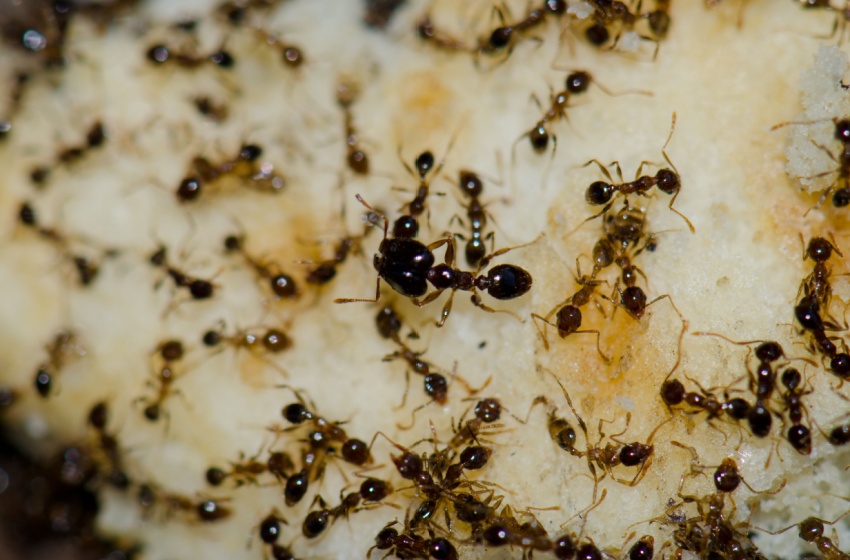
If you live in Visalia, you have had ants in your house. Maybe it was a trail across the kitchen counter that appeared overnight. Maybe it was a line of tiny workers marching along the bathroom baseboard toward the sink. Maybe it was that unsettling moment when you opened a cabinet and realized they had found the sugar. Whatever the scenario, the experience is universal here—and the reasons ants are so persistent in Visalia houses have everything to do with the San Joaquin Valley itself.
The Climate Never Shuts Them Down
In parts of the country with harsh winters, ant colonies go dormant for months. Populations reset. Foraging stops. Homeowners get a break.
Visalia does not work that way. The Central Valley’s mild winters rarely produce sustained freezing temperatures. Ant colonies survive from year to year with minimal die-off, and populations accumulate over time rather than resetting each winter. By the time spring arrives and colonies enter their expansion phase, the population base is already large—and it only grows from there.
Summer is when ant activity inside Visalia homes reaches its peak, and the driver is not food. It is water. When ground surface temperatures climb above 100 degrees—which happens routinely from June through September—the upper soil layers where ant colonies forage become inhospitable. Colonies send workers into cooler, moister environments, and your air-conditioned home with its plumbing and condensation is exactly what they are looking for. Kitchen sinks, bathroom faucets, dishwashers, pet bowls, and condensation on cold water pipes all become targets.
Irrigated Landscapes Create Perfect Nesting Conditions
The San Joaquin Valley is one of the most irrigated residential landscapes in the country. Lawns, planting beds, drip systems, and sprinklers are standard features of Visalia homes. That irrigation creates a consistent moisture layer in the soil near foundations—exactly the conditions Argentine ants need to establish and maintain large colonies right next to your house.
In a non-irrigated environment, ant colonies are limited by natural rainfall. In Visalia, irrigation eliminates that limitation. Colonies near irrigated landscapes have reliable, year-round access to moisture, which supports larger colonies, more queens, and faster expansion.
Argentine Ant Super Colonies
The dominant ant species in the Central Valley is the Argentine ant, and it is not an ordinary ant. Argentine ants form supercolonies—massive interconnected networks of nests with multiple queens that cooperate rather than compete. A single supercolony network can span an entire neighborhood.
This matters for two reasons:
- Treating a single yard may not be enough. The broader colony network extends beyond your property, and it can quickly recolonize treated areas from neighboring yards and common spaces.
- Repellent sprays make things worse. Consumer sprays that contain repellent chemicals cause Argentine ant colonies to “bud”—the colony splits and establishes new nesting sites. You end up with more colonies and more entry points than you started with.
Effective Argentine ant control requires non-repellent products that workers carry back to the colony, combined with recurring service that maintains consistent pressure over time. That is the professional approach—and it is the one that actually works.
Agricultural Proximity
Visalia is surrounded by agricultural land—orchards, row crops, dairies, and open farmland. This landscape supports enormous ant populations. As land is developed for housing, those existing populations do not disappear. They integrate into the residential landscape. And the ongoing agricultural activity continuously introduces new ant populations through soil movement, irrigation, and seasonal cycles.
What Actually Stops Them
The combination that works in Visalia:
- Professional treatment using non-repellent products that spread through the colony
- Recurring service that refreshes the barrier before it degrades
- Reducing moisture near the foundation—adjust irrigation, fix leaks, pull mulch back
- Sealing entry points—caulk cracks, replace weatherstripping, seal around utility penetrations
- Keeping food and moisture sources inside the home cleaned up and minimized
San Joaquin Pest Control has been managing ant problems across the San Joaquin Valley since 1972. The team knows which species are present, how they behave in this specific climate, and which treatment strategies deliver lasting results—not temporary suppression.
If ants have become a way of life in your Visalia house, contact San Joaquin Pest Control for a free quote and find out what 50 years of experience can do about it.